Thursday, June 12, 2008

The BN's or PM's fatal remedy?

Dzulkefly Ahmad

Granted, the price of crude oil as on Wednesday (June 4) was US$125 (RM404) per barrel and has been increasing ever since. A saving of RM13.7 billions were expected when the announcement of the fuel subsidy cuts were made on that historical day. Petrol prices were raised by 41% to RM2.70 from RM1.92 effective June 5, while the price of diesel was increased by RM1 to RM2.58, a jump of 63%.
MCPX

As if that wasn’t excruciating enough, the government simultaneously announced that effective July 1, electricity rates will be raised by 18% for households and 26% for industrial and commercial users. A double whammy!

Inflation floodgate opens wide

The impact? Doubtless, a wide-ranging ramifications for both consumers and businesses. The various daily media carry the full impact of this unfolding catastrophe. The cost of living and cost of doing business, already escalating, will soar up even higher! After foolhardily opening widely the floodgate of inflation, the BN government is now desperately mitigating its full knock-on impact through various rebate measures. Weird.

One could vividly recall that Domestic Trade and Consumer Affairs Minister Shahrir Samad was repeatedly saying that there will be no fuel hike right up to late Wednesday morning. It will not be raised until August, he reassured. Well, one could equally recall the promise by the deputy premier during the launching of the BN manifesto on February 2008 that there shall be no fuel hike in 2008. After a four- hour cabinet meeting on that historical Wednesday the premier frantically made the bizarre announcement, as if an Armageddon is to befall the nation, if we failed to do so.

The question one wishes to ask the premier would definitely be, why took on such drastic action? Irresponsible, if I were to be polite and or plainly reckless, if I were to be in my parliamentary or default mode. While the knee-jerk response of the rakyat was to immediately make a beeline for the petrol stations up to 1 am on Thursday morning, rest assured that the rakyat is not taking this lying down, this time round.

No matter how the government attempts to rationalize its action, the public will not stomach it. Especially not after the last general election where the BN not only suffered a bloody-nose but was literally ‘massacred’. They now come face-to-face with a more well-informed citizenry or a more ‘enlightened’ voters. Thanks to the ‘New Media’ that has empowered the rakyat to make informed decisions. That’s why they simply couldn’t hoodwink them anymore, not anymore.

The attempts at comparing our petrol prices with non-oil producing neighbours like Thailand and Singapore were both ludicrous and pathetic. Let’s not compare with the affluent OPEC states. To cite but a few examples Nigeria is charging her citizens at RM0.32 per liter and Iran at RM0.35 per liter. Indonesia that has become an oil-importing nation is charging RM1.85 per liter. President Chevez could maintain charging the Venezuelans RM0.16 per liter and the economy still remains robust.

But before we go on the debate, let’s get a few things straight.

Macroeconomics 101 - Subsidy or no subsidy


Firstly, subsidy or no subsidy is a matter of choice for the government of the day, as is also on taxation and all its various types; the direct or indirect tax. To increase or reduce it is also a matter for the government of the day to decide. These are the stabilization policies with which any government is capable of ‘moderating’ so as to achieve certain targets in the macroeconomics, namely growth, inflation and employment. This simply put, is the Fiscal Policy, while the government could also moderate the Monetary Policy that involves the money supply and changes in the interest rate by the BNM.

Getting into the debate proper, any subsidy or a payment by a government agency to producer of goods, intended to make prices lower is beneficial for the rakyat. The subsidy will also have the effect of raising the income of the rakyat. The fuel subsidy, being an important component of all products of food, transport and services, is undoubtedly important, as it not only makes the fuel prices lower but more importantly it avoids the inflationary pressure once the price of fuel is raised, when the subsidy is reduced or withdrawn.

Let’s hear the government side of the argument. The subsidy is no longer tenable because of the spiraling global crude oil prices. The government would have had to spend RM33 billion for the fuel subsidy this year, if they have not cut its subsidy by RM13.5 billion. The fuel subsidy, said the second Finance Minister is equal to our development budget annually. We could ill afford this. We could do a lot more with that money. Admittedly logical and sound but do we end there?

The real beneficiaries

Well, in May 2006, the government reduced its subsidy by RM4 billion promising to upgrade the public system of transportation. Is our public transport better off or worse off now? So were the less-off segments of our society or the marginalized rakyat aided by the cut in the subsidy after all, as they presumably will be utilizing the public transport most? So where did the RM 4 billion go to? So, who were the real beneficiaries? By extension, who will be the beneficiaries of the current subsidy cut of RM13.7 billions? Which lucky (read crony) companies will be awarded new projects and who benefited most from insider information and racking in millions on the TNB shares that shot up after the announcement on its tariff increase?

By the way, we are still a net exporter of oil. The Petronas Group delivered another record performance for the financial year ended 31March 2007, amidst a more complex and increasingly challenging global oil and gas industry environment. A total revenue of RM184.1 billion were recorded with a Profit Before Tax of RM76.3 billion. Petronas has a total asset of RM294.6 billion.

Talks of Petronas’ oil drying up come 2014 are contrary to its report. Even the Minister is selectively ignorant. The Group’s continuous effort to replenish the nation’s hydrocarbon resources have resulted in a fairly constant reserve life for Malaysia – an average of 20 years for crude oil and condensates and 34 years for natural gas reserves respectively, at current rate of production. One of the Group’s significant achievements in the Exploration and Production sector during the year was its success in replacing more hydrocarbons than what was produced in Malaysia, with a respectable Reserves Replacement Ratio (RRR) of 1.8 times, which is among the highest in the industry (based on 2006 report).

Let’s do a back-of-the-envelope arithmetic together. Incidentally an audited account of Petronas has never been presented in Parliament. We are often told that we produce 650,000 barrels of crude oil per day, while consuming approximately 400,000 barrels. We have still a net of 250,000 barrels to be exported per day. We were also told that for every US$1 increase in crude oil price, we are in to make an extra RM200 million per year approximately. Hence, from the last fuel hike back in May 2006 when the crude price of oil was US$65 per barrel, with US$125 per barrel as on last Wednesday, the increase is US$60.

Assuming, not much changes in every other costs, we should have made a whooping RM12 billion from the price hike in global crude oil from May 2006. With the willingness of the ‘repentant’ PM and his ‘remorseful’ Cabinet to be on ‘austerity drive’, ie 10% cut in various allowances after their last bad outing in the 12th GE as an ‘atonement’ for all their excesses and ‘sins of omission and commissions’, we are in to save a cool RM2 billion. Wish they knew about ‘austerity’ a lot earlier. Hundreds of billions could have been saved and invested in our Sovereign Funds for our grandchildren! Mind you, Malaysia has one of the highest resources per capita in the world. But where are we now?

Our back-of-the-envelope calculation shows that this could take care of the RM13.7 billion in the extra subsidy required as to take for the increase in the global crude oil price. But this surely wasn’t the way the government would like to go. She has in fact taken a ‘bold’ step in an attempt at dismantling the entire fuel subsidy approach which she now neither believes to be any longer tenable nor desirable.

The PM’s Waterloo

While this writer may be willing to concede that subsidies especially coupled with the multi-layered price-control and the BN’s APs cum monopoly policies, have created huge distortions in the economy, misallocation of resources, leakages, huge bailouts and protection of uncompetitive industries, doing it the ‘BN Way’ may be more aptly described as the ‘medicine killing the patient’ – The Fatal Remedy!

The writer can’t help sharing that he has a hunch that the premier is again deliberately ill-advised as to ‘finish-him-off’ altogether, albeit politically. So the BN’s remedy may turn out to be equally fatal for him – his Waterloo of sort.

Given a citizenry that has long been pampered by the BN misguided populist policies on price control and subsidies, the need for a more holistic and integrated policy change is all the more pressing. With it, would be the need to revisit the concept of prioritization in development, of sustainable growth, of attaining global competitiveness, of avoiding crony practices, of avoiding wastage and excesses and remaining prudent both in fiscal and monetary policy and exercising good governance. The long-outstanding dire low wages scheme needs to be revisited. Above all, we would like to remain caring and yet provide opportunities for all to be enterprising and competing fairly. The Pakatan Rakyat federal government will surely like to do it “Our Way”.

A thorough deliberations and discourse is surely in order. Not here though. As for now, the writer’s critique on the fuel hike hinges on the fact that the policy changes are indeed precipitating the disastrous cascade of fatal injury to all. To the lower-income groups, talk of changing lifestyle is simply nonsensical.

Recalling a parliamentary debate, a BN minister explained that food accounts for the 33% of the CPI, while fuel, transport and communications contributed 15.9% of the CPI weights. With a 41% petrol hike and up to 26% in electricity tariff, we are about to witness an inflationary pressure that may very well be unprecedented. Some are already predicting it to be as high as 7%.

With the government admitting that private consumption accounted for more than 50% of the GDP and growth is essentially domestically driven, we are now set to witness a slowing down or a meltdown of the economy. With lower disposable income and a rising debt burden, weaker private consumption growth, the impact on the overall macro-economy will be even more gruesome.

It doesn’t really matter to the rakyat whatever the growth number or CPI may eventually be. However, it certainly will hurt them most when food could no longer be on the table, as the exorbitant prices will be very prohibitive while the holes in the pockets getting deeper. The knock-on social impact, on the back of an already overburdened nation plagued with crimes, are both immensely scary and onerous.

In this sense, the policy prescription has been regrettably irresponsible and ostensibly reckless.


DR DZULKEFLY AHMAD is director, PAS Research Centre and member of Parliament for Kuala Selangor.

Nik Aziz slams fuel price hikes

Beh Lih Yi (Malaysiakini)

Kelantan Menteri Besar Nik Abdul Aziz Nik Mat has called the move to hike fuel prices as "unwise" and questioned as to why the federal government did not adopt a better alternative.
MCPX

Fresh from his return from a 13-day umrah pilgrimage, the PAS spiritual leader suggested that the government could have promoted the use of natural gas for vehicles (NGV) over petrol and diesel as a solution to the rising world oil price.

nik aziz interview in kota bharu 120608 02"The decision is unwise, why can't we introduce the use of (natural) gas... the unwise people can't run the country," he told journalists at his home in Pulau Melaka, which is about 20-minute drive away from Kota Bahru, Kelantan today.

Nik Aziz said he was "very worried" when he was informed during his umrah of the huge fuel hike which came despite the federal government's assurance to reduce the people's burden.

Last week Prime Minister Abdullah Ahmad Badawi announced that the petrol price will see a 40.6 percent rise to RM2.70 per litre while the price of diesel by a whopping 63.3 percent to RM2.58 per litre.

Cheaper, environmentally-friendly

Elaborating on this, Nik Aziz said the government could have considered and come out with measures to promote the use of NGV as it was cheaper and environmental-friendly.

Apart from that, the seasoned politician - who was reading out from a note - said the amount of gas reserve in the country could last for 35 years compared with the oil reserves for 20 years.

nik aziz interview in kota bharu 120608 01"So why don't we use gas? This is what we should question the government. I am embarrassed when I look at our neighbouring country Thailand which has been using it for a long time.

"The (Malaysian) government is willing to let the people suffer," he argued further.

At present, most users of natural gas are city taxis.

Meanwhile, Nik Aziz also threw his support behind a planned massive demonstration on July 5 organised an opposition-led coalition to protest against the fuel hike.

"This is their basis right... If (the government) doesn't want demonstration, don't do something which is against the people's wish, then there won't be any demonstration," stressed the PAS leader.

The opposition-led anti-fuel hike coalition is seeking to mobilise a record one million people for the mammoth rally at the Kuala Lumpur City Centre next month.

The rally, which was initially slated for July 12, was brought forward to July 5 for tactical reasons, said the organisers today.

MAS to raise fuel surcharge

KUALA LUMPUR, June 12 — National carrier Malaysia Airlines (MAS), engaged in a fare war with budget airline Air Asia, is looking to raise its fuel surcharge in two weeks on a route-by-route basis, chief executive Datuk Idris Jala said today.

"Over the past year, we have increased our fuel surcharge five times in the light of the ever increasing fuel prices," he told Bernama after the launch of MAS's Second Quality Assurance Conference and Business Assurance and Control Assessment (BACA) initiative.

Idris said the entire airline industry was going through a crisis as result of rising fuel prices. "If the oil prices stay at the current levels, a lot of airline companies could go bankrupt."

MAS currrently charges between US$12 (RM39.24) to US$109 (RM356.43) in fuel surcharges for domestic and international destinations.

International jet fuel prices have been rising in tandem with global crude oil rates, touching US$168.1/barrel up 92.7 percent from a year ago, reported energy information provider Platts. Crude oil touched US$139/barrel this week.

Malaysia cut subsidies and raised pump prices for petrol and diesel last week as soaring global crude oil prices were eating into the government's development budget allocations. However, Prime Minister Datuk Seri Abdullah Ahmad Badawi has ruled out further price jumps.

While crude oil prices started rocketing this year, MAS slashed fares in its Everyday Low Fares programme in April, extending it to Asean destinations last month, prompting Air Asia to launch its own Sub-Zero fares programme for domestic and international routes. Both airlines were trying to fill seats as people took other options or cut their travel plans.

Ironically, Air Asia on May 12 responded to MAS's new fares by cutting RM5 from its fuel surcharge of RM16 within Peninsular Malaysia and RM43 for flights that cross the South China Sea to Sabah and Sarawak.

Both airlines recently reported figures for their first quarter of 2008 with MAS slipping in profits while Air Asia's were higher.

MAS reported a net profit of RM120.06 million for the first quarter ended March 31, down 9.5 percent from RM132.71 million a year ago with operating profit slipping to RM132.9 million from RM146.8 million a year ago on higher operating expenses mainly from the increase in fuel cost. Revenue was higher at RM3.75 billion against RM3.54 billion a year ago.

Air Asia, however, posted substantial gains with a net profit of RM161.27 million for the first quarter ended March 31, up 85.6 percent from RM86.87 million a year earlier, boosted by an improvement in its operations, foreign exchange gains and deferred taxation.

Its revenue climbed 31 percent to RM535.15 million from RM406.22 million previously. Gross profit from operations soared 39.2 percent to RM129.31 million from RM92.88 million while pre-tax profit jumped 155 percent to RM110.1 million from RM43.07 million.

From The Malaysian Insider

Minyak naik harga, hampir 400 nelayan Sungai Pahang merana

Hashim Abdullah (Harakahdaily)

TEMERLOH,12 Jun- Tindakan kerajaan menaikkan harga petrol di pasaran menyebabkan hampir 400 nelayan Sungai Pahang di daerah ini lumpuh.

Justeru mereka mendesak agar kerajaan segera mengiktiraf mereka dengan pemberian subsidi minyak sebagaimana yang dinikmati nelayan laut.

Nelayan sungai di Pahang mula diperundangkan kegiatan mereka pada tahun 1991 di bawah enakmen Kaedah-Kaedah Perikanan (Perairan Sungai) 1991.

Di bawah peraturan ini semua nelayan telah dikenakan bayaran lesen menangkap ikan seperti lesen bot, lesen menjaring ikan dan juga lesen jaring hanyut atau disebut lesen menghanyut.

Malangnya, kata nelayan kepada wartawan Harakahdaily dalam satu pertemuan dekat sini baru-baru ini, kerajaan tidak pernah mengambil peduli untuk membela nasib mereka seolah-olah tiada pengiktirafan dibuat sebagaimana nelayan di laut.

Dalam tinjauan wartawan mendapati semua bot nelayan Sungai Pahang menggunakan enjin berkuasa 18 kuda ke bawah menggunakan petrol dan kenaikan harga minyak petrol dipasaran sudah tentu menyempitkan kehidipan mereka.

"Kalau keadaan kami dibiarkan macam ini lumpuhlah kegiatan kami. Hidup kami bergantung kepada rezeki di sungai. Tapi, kalau minyak naik kerajaan pula tak pandang kami, macam mana kami nak hidup, nak dapatkan ikan masa ini bukannya senang, sempitlah hidup kami," rungut mereka.

Bagi Zulkifli Masri dari Kampung Paya Kecik Hulu, beliau berkerja kampung dengan mengambil upah menorah getah orang, juga menjadikan aktiviti menangkap ikan di sungai sebagai punca pendapatan. Kini pendapatannya kian terjejas akibat kenaikan petrol dan ketiadaan subsidi.

"Keadaan nelayan di sungai sekarang dah jauh berubah. Dulu orang cari ikan untuk tujuan makan sendiri. Mereka naik perahu. Kini, kami nelayan sepenuh masa. Ada di antara kami mencari ikan sebagai pekerjaan utama. Kami guna bot petrol. Kadang-kadang dapat tangkap ikan. Tapi, ada masa tangkapan kami kosong. Minyak terus naik, mana nak cari makan,"keluhnya.

Sementara itu, Mazlan Sidek kesal kerana golongan miskin sepertinya tidak dipedulikan kerajaan sedangkan jumlah nelayan sungai dari hari ke hari semakin bertambah.

"Kalau ikutkan jumlah orang cari nafkah di sungai ini lebih ramai dari yang didaftarkan seramai 400 itu. Itu yang berlesen sedangkan ramai lagi orang cari ikan tak berlesen. Ini menunjukkan isu nelayan sungai bukan isu kecil lagi. Tapi, kami macam tak dipedulikan,"kesalnya.

Opposition plan for mass fuel hike protests

KUALA LUMPUR, June 12 — Opposition groups today vowed to push ahead with plans for mass protests against a sharp 41 percent hike in gasoline prices, despite the government's pledge not to further raise prices this year.

The price hike last week has sparked sporadic protests nationwide. Prime Minister Datuk Seri Abdullah Ahmad Badawi sought to calm public anger, promising yesterday to keep prices fixed at the current level for the rest of the year.

Shamsul Iskandar Akin, a leader of the GERAMM youth coalition against oil price hike, dismissed Abdullah's pledge and said the hike has led prices to rise across the board and caused further hardship for the poor.

Malaysia as a net oil exporter, benefits from rising global oil prices and people are questioning why profits from national oil firm Petronas aren't used as subsidies, he said.

"The government's action (to raise prices drastically) is crazy. It shows their failure in managing the economy," he told reporters. "We will continue with peaceful protests to demand the government reverse its decision. A march is planned tomorrow from a mosque in downtown Kuala Lumpur to the Petronas Twin Towers, where Petronas headquarters is based."

Police, meanwhile, have said they may have to close the road leading to the Kampung Baru mosque where protestors are scheduled to gather after Friday prayers tomorrow.

Kuala Lumpur police chief Datuk Wira Muhammad Sabtu Osman said between 1,500 and 2,000 members of the security forces from the police, Rela and Federal Reserve Unit would be placed on alert to stop the procession.

"Personnel from the Dang Wangi and Sentul district police stations will also maintain security in the area. We will close several roads leading to the (mosque) area if necessary," he said.

Besides the march, GERAMM and PROTES, another anti-inflation coalition of Opposition parties and non-governmental groups, hope to also gather a million people for the largest mass demonstration in Kuala Lumpur next month, Shamsul said.

In addition, GERAMM has launched an online petition to gather a million signatures to protest the price hike, he told reporters.

The pump price of gasoline was raised from June 5 by 41 percent to RM2.70 a litre. Diesel prices shot up 63 percent to RM2.58 per litre.

Like other Asian nations, Malaysia says fuel subsidies are no longer tenable amid rising world oil prices. In addition to the fuel price hike, the government also raised electricity tariffs from July.

The energy price hike is a politically risky move for Abdullah, who is fighting for his political survival after his ruling coalition's shock election losses in March.

Despite the increase, the government says Malaysia's gasoline prices remain lower than other Asian countries such as Singapore, Thailand and India.

Shamsul said the comparison was unfair as those were non-oil producing nations. In contrast, gasoline prices in Indonesia are about a third cheaper than Malaysia, he said. — AP, Bernama

Demo Protes dicepat kepada 5 Julai

Tarikh perhimpunan besar-besaran membantah kenaikan harga minyak yang dirancang di ibu negara telah dipercepatkan kepada 5 Julai.

Sebelum ia dijadual diadakan di KLCC pada 12 Julai.

Menurut naib ketua Angkatan Muda Keadilan (AMK), Khairul Anuar Ahmad Zainudin, mesyuarat Gabungan Anti-Inflasi (Protes) petang ini memutuskan untuk mempercepatkannya.

Beliau bagaimanapun enggan mengulas lanjut.

"Protes akan mengeluarkan kenyataan untuk menjelaskan sebab-sebab tarikh baru itu dipilih," katanya ketika dihubungi Malaysiakini selepas mesyuarat tersebut.

Dalam satu sidang media di sebelah pagi anjuran satu gabungan baru Gerakan Rakyat Anti Manipulasi Minyak (Geramm), Khairul Anuar berkata, tarikh 12 Julai yang dicadangkan Protes bukan tarikh muktamad.

Di sidang media itu, ketua AMK Shamsul Iskandar Mohd Akin mengumumkan satu siri jelajah seluruh negara dalam bentuk ceramah dan demonstrasi kecil diadakan untuk bantahan yang sama.

Geramm ditubuhkan oleh AMK pada 9 Jun bersama beberapa kumpulan bukan kerajaan termasuk Pertubuhan Kebangsaan Pelajar Islam Malaysia (PKPIM).

Jelajah itu akan berlangsung selama dua minggu, bermula dari 14 Jun di Pahang hingga 29 Jun di Selangor, Johor dan Sabah.

Selain Lembah Kelang, siri bantahan Geramm meliputi Perak, Pahang, Negeri Sembilan dan Melaka, tambahnya.

Geramm juga mengadakan kempen 'petisyen rakyat' untuk mendapatkan sejuta tandatangan orang ramai terutama kelompok muda yang begitu terjejas dengan keputusan tiba-tiba kerajaan ini yang dianggap kadar kenaikan petrol dan diesel paling besar serta mengejutkan.

"Petisyen itu juga boleh didapati secara dalam talian di laman web www.geramm.org," kata Shamsul Iskandar.

Wednesday, June 11, 2008

Pakatan Rakyat boleh turunkan harga minyak

Husam Musa, Naib Presiden PAS

Jika Kerajaan BN tumbang, bolehkah harga minyak diturunkan semula?

Saya penuh yakin kita boleh menurunkannya sekali pun harga minyak dunia terus meningkat.

Satu dari strategi mudah dan praktikal ialah meluaskan penggunaan gas, baik LPG atau NGV untuk domestik, termasuk untuk kenderaan.

Bila lebih banyak gas digunakan, kita kurang menggunakan minyak. Lebih banyak pula minyak kita dapat di eksport dan kita mendapat lebih banyak wang. Wang minyak itu kita gunakan untuk mengekalkan harga minyak tempatan dan kita sendiri menggunakan lebih gas dari minyak.

Sebagai 'net exporter' minyak dan gas, Malaysia mendapat keuntungan yang banyak dari kenaikan harga minyak dari hasil penjualan lebihan hasil petroleum Negara.

Jika dicampurkan pengeluaran gas dan minyak negara jumlah keseluruhannya melebihi 1.7 juta tong sehari. Namun penggunaan Negara termasuk gas asli adalah kurang dari 1 juta tong sehari. Oleh itu subsidi yang diberikan masih boleh ditanggung oleh kerajaan.

Kenaikan harga minyak adalah kerana kegagalan pihak kerajaan BN merancang dan melaksana polisi tenaga Negara yang berkesan. Tidak ada satu forum untuk pakar-pakar terlibat sama merancang dasar tenaga negara kerana National Petroleum Advisory Council (NPAC) yang diwujudkan bersama lahirnya Petronas dulu mungkin telah menjadi arwah.

Apa yang boleh dilakukan oleh kerajaan PR ialah menurunkan harga minyak petrol dan disel dan seterusnya memperkembangkan penggunaan NGV dan gas asli untuk industri dalam tempoh tiga tahun bermula dari sekarang. Rakyat yang perlu berjimat boleh menggunakan NGV yang lebih murah dan mudah diperolehi dan rakyat yang berkemampuan boleh terus menggunakan bahan petrol yang lebih mahal.

Mari kita lihat kecacatan dasar tenaga kita sekarang.

NGV (Natural Gas for Vehicle)

Penggunaan bahan petroleum Negara ialah kira-kira 590,000 tong sehari.

Pengunaan bahan petroleum pasti dapat dikurangkan dengan bertambahnya penggunaan gas seperti NGV yang tentunya lebih murah. Kerajaan dengan itu dapat kurangkan kos subsidi minyak tanpa perlu naikkan harga minyak.

Sumber gas asli kita begitu kaya.

Malaysia adalah antara negara yang terbaik di rantau Asia dalam mempunyai rangkaian saluran paip gas asli - PGU. (Peninsula Gas Utilisation) Malang, penggunaan gas asli hanya tertumpu kepada stesen janakuasa dan industri tertentu sahaja. Rangkaian saluran gas PGU yang telah merangkumi semua negeri di semenanjung Malaysia, kecuali Kelantan, tidak digunakan sepenuhnya.

Setakat ini, Petronas hanya memiliki kurang dari 40 stesen NGV dalam negara. Jumlah ini tidak sampai 5% stesen yang dimiliki Petronas. Memandangkan hanya Petronas yang berhak membangunkan stesen NGV maka nyatalah Petronas tidak menumpukan usaha sepenuhnya ke arah meluaskan lagi kegunaan bahan bakar ini. Banyak industri yang perlukan bekalan gas asli dari system PGU untuk operasi mereka, gagal memperolehinya.

Dengan sumber gas asli yang begini banyak, rakyat negara ini sepatutnya sudah dapat merasakan faedah dan nikmat. Ia tidak berlaku kerana kurang perancangan dan visi.

Nyata benar lemahnya kerajaan pimpinan Abdullah. Negara kita tidak kekurangan sumber tetapi kekurangan kesungguhan dan kebijaksanaan.

Petronas yang telah gagal melaksanakan program NGV seharusnya tidak lagi terlibat dalam 'sales and distribution' untuk NGV dan gas asli. (buat masa ini pun penjualan gas asli kepada industi dilaksanakan oleh Gas Malaysia.)

Sebaliknya, Petronas seharusnya bertindak sebagai pembekal pukal dan memastikan bekalan mencukupi untuk keperluan rakyat.

LNG (Liquified Natural Gas)

Apa yang dilakukan oleh Petronas untuk sumber gas asli ini ialah dengan mengeksport LNG (gas asli cecair).

Penjualan LNG adalan sebanyak 22 juta tan setahun. Ini bersamaan dengan hampir 500,000 tong sehari minyak mentah iaitu hampir memenuhi keperluan bahan petroleum negara.

Penjualan LNG memerlukan kos memproses dan penghantaran yang tinggi. Oleh itu keuntungan menjual LNG adalah kurang berbanding minyak mentah. Seharusnya Petronas mengalakkan pengunaan gas dalam Negara yang akan membolehkan Petronas mengekspot minyak mentah yang lebih menguntungkan.

Pada masa ini Petronas membelanjakan lebih US$ 0.5 billion setahun untuk pengangkutan LNG ke destinasi pembeli. Untuk tempoh 20 tahun (jangkamasa perjanjian penjualan) kos ini adalah sebanyak US$10 billion. Wang sebanyak ini bukankah lebih baik di gunakan untu membina saluran paip gas di antara Sabah, Sarawak (tempat sumber) dan Semenanjung bagi membolehkan sumber gas asli ini disalurkan ke seluruh Negara?

Oleh itu kontrak penjualan LNG harus dikaji semula dan tumpuan harus di berikan dalam mengalakkan pengunaan gas asli untuk kenderaan dan industri di seluruh negara.

Pakatan Rakyat tak boleh laksanakan langkah semudah ini? Tentu boleh.

Kita masih ada pilihan antara dasar semborono yang menyusahkan semua pihak dengan dasar yang lebih menguntungkan kita: antara BN dan PR. - cetusan-hati.blogspot.com.

Lagi Jadual PROTES Kenaikan Harga Minyak Anjuran JERIT, PSM & Pakatan Rakyat

Beberapa bantahan terhadap kenaikan harga minyak akan diadakan di sekitar Kajang, Bangi dan Semenyih. Orang ramai dijemput hadir dan turut serta dalam menuntut pihak Kerajaan menurunkan harga minyak.
  1. 15 Jun 2008 - Petronas Seksyen 15 Bandar Baru Bangi (dekat tol Bangi), jam 9.30am
  2. 22 Jun 2008 - Petronas Kajang (depan Kajang High School), jam 11.00 pagi
  3. 29 Jun 2008 - Petronas dekat Pekan Semenyih, jam 10.00 pagi

Kuasa di tangan rakyat untuk membawa perubahan. Jom PROTES ramai-ramai !

Anjuran Bersama :

JERIT, PSM & PAKATAN RAKYAT

Tuesday, June 10, 2008

Demo harga minyak di Terminal One Seremban 14 Jun ini - Protes Negeri Sembilan

Wan Nordin Wan Yaacob (Harakahdaily)

KUALA LUMPUR, 11 Jun (Hrkh) - Kenaikan harga minyak yang diumumkan kerajaan minggu lalu menimbulkan kemarahan pelbagai pihak, sementara banyak himpunan aman telah dan akan diadakan.

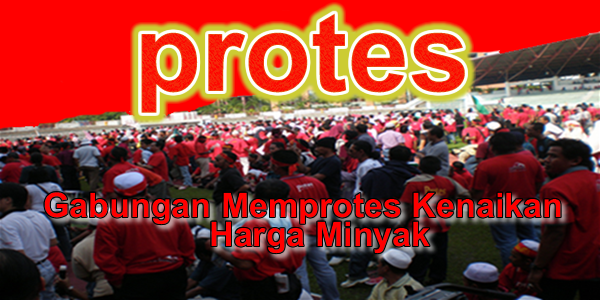
Terbaru, Sekretariat Gabungan Gabungan Memprotes Kenaikan Harga Minyak (Protes) peringkat Negeri Sembilan yang diketuai oleh, Zulkefly Mohamad Omar menyatakan komitmen akan mengadakan himpunan aman pada 14 Jun ini.

Dalam satu mesyuarat yang diadakan di Pejabat Perhubungan PAS Negeri Sembilan di Seremban semalam, jawatankuasa bersetuju dengan Himpunan Aman yang bakal diadakan di Terminal One, Seremban pada 14 Jun 2008.

Antara yang hadir dalam mesyuarat itu semalam ialah, pimpinan Badan Perhubungan PAS Negeri Sembilan, Pengerusi DAP Negeri Sembilan, Loke Siew Fook, sayap Pemuda Parti-Parti Politik Pakatan Rakyat (KeADILan, DAP, PAS) dan Badan Bukan Kerajaan (NGO).

Dalam mesyuarat tersebut Sekretariat Protes Negeri Sembilan merakam jutaan terima kasih atas penghormatan yang diberikan oleh Protes Pusat yang telah memilih Negeri Sembilan sebagai negeri pertama dalam 'Roadshow Protes; di seluruh negara bagi membantah kenaikan harga minyak.

Menurut Zulkefly, Sekretariat Protes Negeri bersetuju untuk mengadakan himpunan aman ini diadakah di hadapan Kompleks membeli belah di Terminal One Seremban.

Ketika ditanya berhubung keselamatan orang ramai semasa himpunan aman ini, Zulkefly yang juga Pesuruhjaya PAS Negeri Sembilan berjanji himpunan ini akan berjalan dengan aman jika tidak ada provokasi dan tindakan oleh pihak yang tidak bertanggungjawab.

Sebelum ini PAS pernah menganjurkan himpunan aman tanpa sebarang gangguan, dan buktinya Himpunan Aman yang diadakan di Pasar Besar Seremban berjalan dengan aman dan semua orang yang hadir bersurai dengan baik dan selamat.

Zulkefly setersunya berharap peristiwa 28 Mei 2006 di KLCC tidak berlaku di mana tindakan ganas serta zalim pasukan polis simpanan persekutuan (FRU) dalam menyuraikan perhimpunan aman membantah kenaikan harga minyak.

Beliau juga berharap pihak keselamatan dapat memberi kerjasama kepada rakyat untuk menyatakan bantahan terhadap kenaikan minyak yang memberi kesan kepada semua pihak tidak kira latarbelakang politik kepartian.

Bagi pihak Sekretariat Protes Negeri Sembilan Zulkefly merasakan perlu untuk meneruskan bantahan aman bagi menyedarkan rakyat mengenai implikasi kenaikan harga minyak dan tarif elektrik yang baru diumumkan.

Selain daripada itu, beliau difahamkan kebanyakan syarikat-syarikat multinasional yang melabur di Negeri Sembilan melahirkan rasa gusar berikutan kenaikan harga minyak yang begitu mendadak.

Keadaan ini jika tidak di kawal bagi mendatangkan mudarat yang lebih besar seperti pekerja-pekerja industri akan kehilangan kerja akibat penutupan kilang-kilang yang ada, katanya.

Anti-fuel hike roadshows begin Saturday

Andrew Ong (Malaysiakini)

The Coalition Against Inflation (Protes) is launching their nationwide roadshows condemning the sharp hike in fuel prices starting this Saturday in Seremban.
MCPX
Protes spokespersons would be issuing a short public statement at the Terminal One shopping mall to mark the start of the campaign at 3pm.

A host of NGO representatives and Pakatan Rakyat elected representatives from the federal and local level would then distribute leaflets at the shopping mall.

“The climax of the launch would be the ceramah in Taman Jasmin, Senawang in the evening where a strong lineup of speakers will be sharing their views on the shocking hike in fuel prices,” said Badrul Hisham Shaharin, who is part of the organising committee for the Seremban roadshow.

seremban pakatan fuel hike protest 110608An application for a police permit was made last Friday and a reply is expected soon.

Since 2006, the Protes coalition - consisting of 57 NGO and five opposition parties - have been organising a series of activities against rises in utility, fuel and toll charges.

Through a series of roadshows throughout the country, the coalition seeks to rally 100,000 people to a mass demonstration in Kuala Lumpur on July 12 against the recent hike in fuel charges.

Police probe

In a related development, police have recorded statements from several Pakatan elected representatives from Negeri Sembilan yesterday over a demonstration in Seremban last Friday.

Among those who have had their statements recorded included state assembly opposition leader Loke Siew Fook (Lobak), assemblypersons Wong May May (Mambau), Cha Kee Chin (Bukit Kepayang), P Gunasekaran (Senawang), Chai Tong Chai (Chuah) and PAS Negeri Sembilan chief Zulkifli Omar.

According to Loke, the demonstration jointly organised by Pakatan Negeri Sembilan took place for one hour at the Seremban market involving some 100 people.

“It was peaceful. We dispersed on our own after making our stand known,” he said, adding that Seremban district police were investigating a report filed by their own officers.

Loke expressed surprise that he was called in for questioning and said that the police action may be a form of intimidation as the Seremban-leg of the Protes roadshow was around the corner.

“This is my second term as an elected representative. Before this, I was involved in many protest before. They were all peaceful and we dispersed peacefully after that.

“In all of those instances, the police had never taken statements from me before, nor had the police lodged a report against us. This is the first time my statements were taken over a peaceful assembly,” he stated.